Curriculum Links
Our programs primarily align with the following Science and HASS (Geography) outcomes from the Australian curriculum. Particular outcomes in the PD/H/PE and English curriculum also fit in with the learning and activities.
Learning with purpose
Across each stage our program aligns with the Cross-Curricular priorities of Sustainability and Aboriginal and Torres Strait Islander Histories and Culture.
- Sustainability
- Aboriginal and Torres Strait Islander Histories and Culture

NSW Department of Education
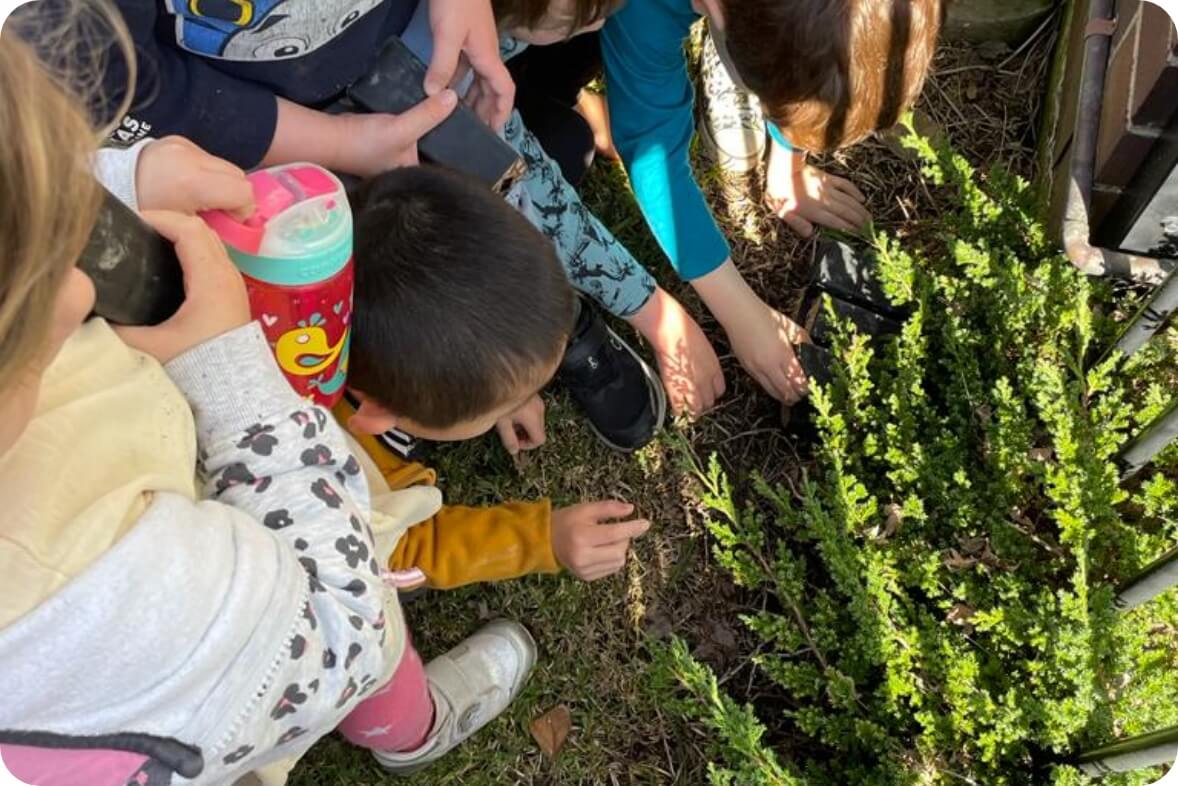
Open the Department of Education classroom resource supporting biodiversity, citizen science and real-world learning.
Stage/Outcome
Early and primary outcomes
Select a stage to view its complete Science, HASS and related curriculum outcomes.
Science
- AC9SFU01 - observe external features of plants and animals and describe ways they can be grouped based on these features
- AC9SFH01 - explore the ways people make and use observations and questions to learn about the natural world.
- AC9SFI01- pose questions and make predictions based on experiences
- AC9SFI02 - engage in investigations safely and make observations using their senses
HASS
- AC9HS1S05 & AC9HS2S05-draw conclusions and make proposals
- AC9HSFK03 - the features of familiar places they belong to, why some places are special and how places can be looked after
- AC9HSFK04 - the importance of Country/Place to First Nations’ Australians and the Country/Place on which the school is located
- AC9HSFS02 - sort and record information including pictorial timelines and locations on pictorial maps or models
- AC9HS2S02 - collect, sort and record information and data from observations and from provided sources, including unscaled timelines and labelled maps or models
- AC9HS1S03 & AC9HS2S03 - interpret information and data from observations and provided sources, including the comparison of objects from the past and present
Maths
- MAE-DATA-01 - contributes to collecting data and interprets data displays made from objects
English
- ENE-CWT-01 - creates written texts that include at least 2 related ideas and correct simple sentences
- ENE-OLC-01 - communicates effectively by using interpersonal conventions and language with familiar peers and adults
Science
- AC9S1U01 - identify the basic needs of plants and animals, including air, water, food or shelter, and describe how the places they live meet those needs
- AC9S1U02 - describe daily and seasonal changes in the environment and explore how these changes affect everyday life.
- AC9S1I01 & AC9S2I01 - pose questions to explore observed simple patterns and relationships and make predictions based on experiences.
- AC9S1I03 & AC9S2I03 - make and record observations, including informal measurements, using digital tools as appropriate
- AC9S1I04 & AC9S2I04 - sort and order data and information and represent patterns, including with provided tables and visual or physical models.
- AC9S1I05 & AC9S2I05 - compare observations with predictions and others’ observations, consider if investigations are fair and identify further questions with guidance
- AC9S1I06 & AC9S2I06 - write and create texts to communicate observations, findings and ideas, using everyday and scientific vocabulary
HASS
- AC9HS1K03- the natural, managed and constructed features of local places, and their location.
- AC9HS1K04 - how places change and how they can be cared for by different groups including First Nations Australians.
- AC9HS1S02 - collect, sort and record information and data from observations and from provided sources, including unscaled timelines and labelled maps or models.
- AC9HS2S03 - interpret information and data from observations and provided sources, including the comparison of objects from the past and present
PD/H/PE
- AC9HP2P06 - investigate a range of health messages and practices in their community and discuss their purposes.
Maths
- MA1-DATA-01 - gathers and organises data, displays data in lists, tables and picture graphs
- MA1-DATA-02 - reasons about representations of data to describe and interpret the results
English
- EN1-OLC-01 - communicates effectively by using interpersonal conventions and language to extend and elaborate ideas for social and learning interactions
- EN1-CWT-01 - plans, creates and revises texts written for different purposes, including paragraphs, using knowledge of vocabulary, text features and sentence structure
Science
- AC9S3U01 - compare characteristics of living and non-living things and examine the differences between the life cycles of plants and animals
- AC9S4U01 - explain the roles and interactions of consumers, producers and decomposers within a habitat and how food chains represent feeding relationships
- AC9S4U02 - identify sources of water and describe key processes in the water cycle, including movement of water through the sky, landscape and ocean; precipitation; evaporation; and condensation
- AC9S3U02 - compare the observable properties of soils, rocks and minerals and investigate why they are important Earth resources
- AC9S3I01 & AC9S4101 - pose questions to explore observed patterns and relationships and make predictions based on observations
HASS
- AC9HS3K07 - why people participate within communities and how students can actively participate and contribute to communities
- AC9HS3S02 & AC9HS4S02 - locate, collect and record information and data from a range of sources, including annotated timelines and map
Maths
- MA2-DATA-01 - collects discrete data and constructs graphs using a given scale
- MA2-DATA-02 - interprets data in tables, dot plots and column graphs
English
- EN2-OLC-01 - communicates with familiar audiences for social and learning purposes, by interacting, understanding and presenting
- EN2-CWT-01 - plans, creates and revises written texts for imaginative purposes, using text features, sentence-level grammar, punctuation and word-level language for a target audience
Science
- AC9S5U01- examine how particular structural features and behaviours of living things enable their survival in specific habitats
- AC9S5I01- pose investigable questions to identify patterns and test relationships and make reasoned predictions
- AC9S5I03 & AC9S6I03 - use equipment to observe, measure and record data with reasonable precision, using digital tools as appropriate
- AC9S5I06 & AC9S6I06 - write and create texts to communicate ideas and findings for specific purposes and audiences, including selection of language features, using digital tools as appropriate
HASS
- While there is no outcome that directly aligns with our program, the concept of citizenship aligns closely with the development of a shared school edible garden.
Maths
- MA3-DATA-01 - constructs graphs using many-to-one scales
- MA3-DATA-02 - interprets data displays, including timelines and line graphs
English
- EN3-OLC-01 - communicates to wide audiences with social and cultural awareness, by interacting and presenting, and by analysing and evaluating for understanding
- EN3-CWT-01 - plans, creates and revises written texts for multiple purposes and audiences through selection of text features, sentence-level grammar, punctuation and word-level language
Years 7-12
Senior school outcomes
Science
AC9S7U02
Use models, including food webs, to represent matter and energy flow in ecosystems and predict the impact of changing abiotic and biotic factors on populations.
Design and Technology
AC9TDE8K04
Analyse how food and fibre are produced in managed environments and how these can become sustainable.
Geography - livability of places
- GE4-MAN-01 - explains the management and protection of places and environments
- GE4-APC-01 - explains Aboriginal Peoples’ Custodianship, care and management of Country
Maths
- MA4-DAT-C-01 - classifies and displays data using a variety of graphical representations
English
- EN4-ECA-01 - creates personal, creative and critical texts for a range of audiences by using linguistic and stylistic conventions of language to express ideas
Geography - Biomes and Sustainable agriculture, environmental change and management and human wellbeing
- GE5-APC-01 - analyses how Aboriginal Peoples’ Custodianship of Country supports environmental management and enhances Community wellbeing
- GE5-MAN-01 - assesses different approaches to the management and protection of places and environments
Maths
- MA5-DAT-C-02 - displays and interprets datasets involving bivariate data
English
- EN5-ECA-01 - crafts personal, creative and critical texts for a range of audiences by experimenting with and controlling language forms and features to shape meaning
Environmental and Earth Science
- Any human activities that affect ecosystems (for example, species removal, habitat destruction, pest introduction, dryland salinity) can directly or indirectly reduce populations to beneath the threshold of population viability at local, regional and global scales and impact ecosystem services (ACSES081)
- Overharvesting can directly reduce populations of biota to beneath the threshold of population viability; the concept of maximum sustainable yield aims to enable sustainable harvesting (ACSES082)
- Producing, harvesting, transporting and processing of resources for consumption, and assimilating the associated wastes, involves the use of resources; the concept of an ‘ecological footprint’ is used to measure the magnitude of this demand (ACSES083)
Agricultural Studies
- P2.1 describes the biological and physical resources and applies the processes that cause changes in plant production systems
- P3.1 explains the role of decision-making in management and marketing of agricultural products in response to consumer and market requirements
- P4.1 applies the principles and procedures of experimental design and agricultural research
For more information, contact us.